
Even those who have not paid attention in the German-performance course know at least a moment, namely the one with the apple that the title hero has to shoot with the crossbow of his own son. Friedrich Schiller has come up with this scene, which should symbolize the courage and spectacular skills of Swiss national hero Wilhelm Tell. According to the current state of historical research, he never really exists, but that comes to the British director Nick Hamm (“The Hole”).
His adventure film “Wilhelm Tell“Although Friedrich Schiller calls the template, but has neither to do too much with Schiller nor with Swiss history. Instead, Hamm stylized his Tell – played by the Danish Günen Claes Bang – to the fearless freedom fighter in the style of Mel Gibson's” Braveheart “, who is against dark villains – Austrian! – fights and his people leads into freedom.

Wilhelm Tell (Claes Bang) leads his people to the battle against the malignant Austrians.
High in the Swiss Alps, the former crusader Wilhelm Tell (Claes Bang) leads a peaceful existence with his patchwork family: he met his wife Suna (Golshifteh Farahani) in the East, his son Walter (Tobias Jowett) comes from an earlier marriage. The field work fills out Tell, he only uses his crossbow to hunt. But the quiet life experiences an abrupt end, because Albrecht, King of Habsburg (Ben Kingsley with a strange golden eye flap), is targeting the Swiss cantons and sends its tax collectors to collect from the neighbors from now on.
In the peaceful Alpine area, the dark governor Gessler (Connor Swindells) has a robbery and rape until the rural population has finally had enough of the Austrian fileaus. The rebellion against the occupiers begins. A farmer who murdered a money collector is protected by Tell. So Tell himself involuntarily becomes rebel-and soon also forced to the legendary Tell shot …
A film for the rough
Since the general knowledge of Wilhelm Tell in the Anglo-Saxon world is probably particularly limited to the most famous scene of the Tell legend, it makes sense that Nick Hamm begins in its more than free adaptation of history at that moment. Much more is not left of Schiller's piece, no hollow alley of Küssnacht is going through whether the Vogt makes its bill with the sky remains open, because Hamm does without lyrical intermediate tones and focuses primarily on the rough.
In the beginning, “Wilhelm Tell” still looks like one of those history films in which attempts are made to separate facts and legends and to peel the historically verifiable truth behind a figures that have been mythically charged over the centuries. But in the event that this should really have been the intention of Jon Hamm, then he quickly put it back in the course of the script letter, so that you prefer to tell a very classic hero story instead – and not even bad!
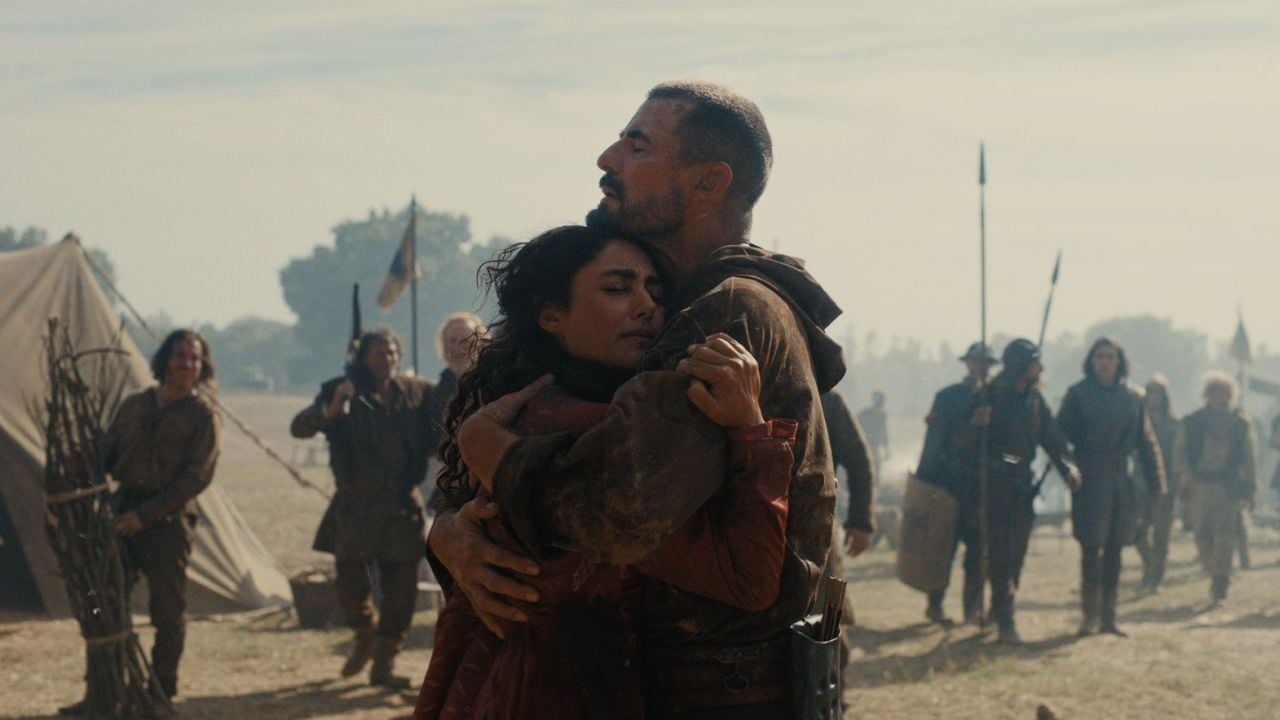
Golshifteh Farahani, as Tell's wife Suna, brings a particularly exciting note to the film.
One can have fun that all figures speak in highly stabbed English and that the actors from Denmark, Iran, England, the USA, are not from Switzerland. Likewise, that the spectacular pictures were not shot in the Swiss Alps by the vastness of the mountains, but in South Tyrol. Authenticity should therefore not be expected here, but as I said: there was no historical Tell anyway. For this, Claes Bang's massive hero seems extremely modern: He has brought a post -traumatic stress disorder from the crusade in the morning, which – as you experience in flashbacks – also destroyed his desire to war. At the right moment, of course, his desire to fight wakes up again and of course Tell did not lose his target, his son will thank him.
He also brought his wife Suny from the East, who turns out to be a resolute, autonomous person. She doesn't just stay at home and keeps the food warm while the man plunges into the fight, no, this protofeminist herself grabs the sword herself and becomes part of the rebellion. Particularly interesting, since it is unmistakable a Muslim, which gives the events an additional cosmopolitan grade: together Christians, Heid- and Muslims fight against oppression, which, given the currently not necessarily for the greatest tolerance, which for example prohibited the construction of minarets a few years ago, has a special grade.
As the Swiss themselves – to put it carefully – “free” interpretation of the legends around their national hero Wilhelm Tell would like to know. Apart from such questions, Nick Hamm's adventure film convinces as a pleasantly old -fashioned heroic story with progressive elements.
Conclusion: Neither with Friedrich Schiller's legendary figure nor with real Swiss history, this “Wilhelm Tell” has too much hat. However, the resulting narrative freedom uses the English director Nick Hamm a very entertaining adventure film in which the Dane Claes Bang with Vera and Pathos as a fighting tired crusader fights the oppression.