Written during the Stalinist terror of the 1930s, then banned for a quarter of a century and only published in 1976 in a censored version: After his appearance, the novel inspired the Rolling Stones, directors such as Roman Polański, Federico Fellini, Terry Gilliam-and also “Moulin Rouge” Mastermind BAZ Luhrmann wanted to film the fabric, but failed because of the implementation. We are talking about “The master and Margarita“The Russian author Mikael Bulgakov, born in Kyiv.
In Russia, the novel has often been filmed for cinema or television, but never as complex as now by Michael Lockshin. The budget for the more than two and a half hours long epic is said to have 17 million euros, international stars such as August Diehl and Claes Bang play the devil or Pontius Pilate. Bizarre fantasy elements are linked to philosophical excursions here-and all of this hides a critical attitude, which makes it even more astonishing that this film could be produced in Putin's Russia.
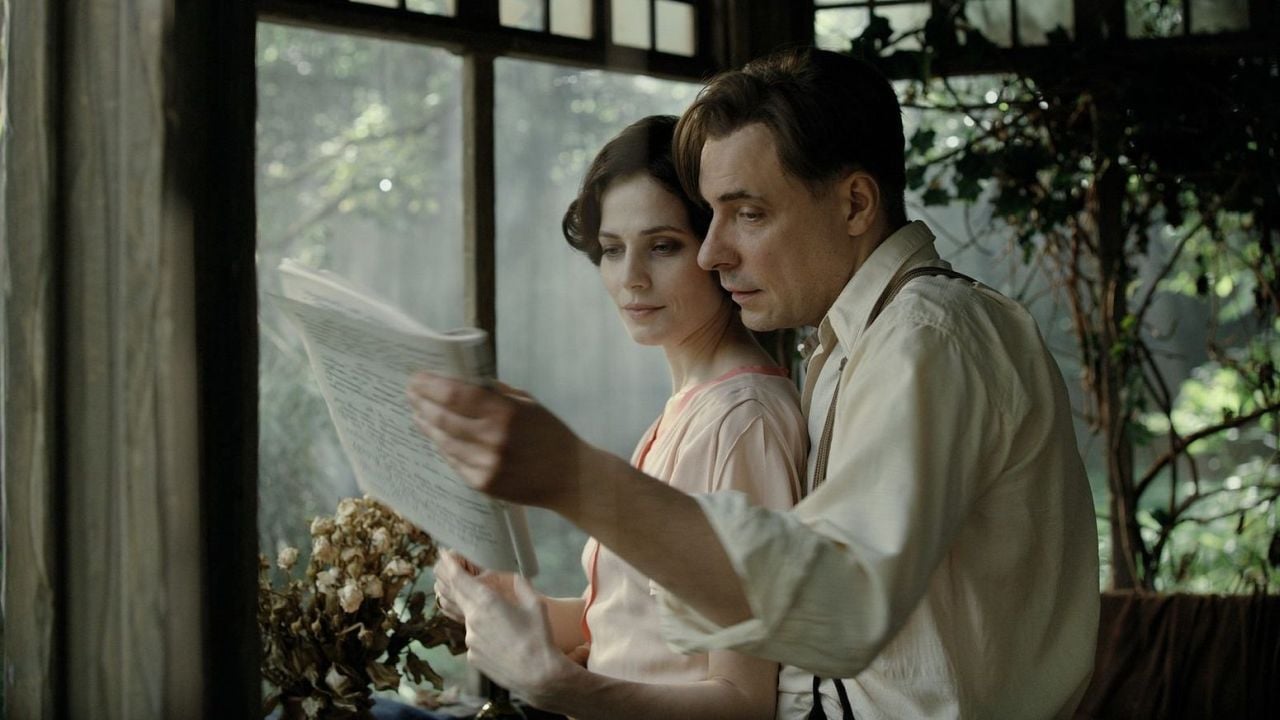
The Namelose Meister (Evgeniy Tsyganov) and his Margarita (Yulia Snigir) set out to write a novel about his own fate.
Moscow, in the late 1930s: Stalin's rule makes it more and more difficult for artists to comment freely. One of those affected is a nameless author (Evgeniy Tsyganov), who has just written a piece about Pontius Pilatus, the Roman governor in Judea, who sentenced Jesus Christ to death on the cross. The rehearsals are interrupted, the piece is prohibited and the author is excluded from the writer's association.
An elegant man, dressed in black, appears from nowhere, who introduces himself as Woland (August Diehl) and soon turns out to be the bodily devil. He spurs the author to write a satirical novel about his fate. Good idea, he thinks and gets to work, supported by his beloved Margarita (Yulia Snigir), who only refers to the author as a master. However, Margarita will soon become a witch and let Moscow burn together with the devil …
The director had to flee from Russia
A German devil who comes to Moscow and ensures chaos. For decades after the Second World War, this certainly has a special grade. But when Mikael Bulgakow wrote this imagination in the 1930s, it was not yet foreseeable what the future should bring. Bulgakow himself no longer experienced it, he died in 1940, the manuscript for his epochal novel “The Master and Margarita” remained under lock and key for a long time and was only able to appear in a shortened version in 1967. No wonder, because the novel is an undisguised criticism of Stalinist politics, cleansing, arbitrary arrests, the oppression of artistic freedom. So pretty much what could also be said about the current Russia among Putin.
It is all the more astonishing that a remake of Bulgakov's novel could be realized with Russian financing, including state cultural support. Directed by Michael Lockshin, a Russian born in the USA, whose parents emigrated to her homeland soon after the son was born. There Lockshin became the director, whose debut “Silver Skates” became the first Russian film financed by Netflix and who is now also a vehement critic of the Russian War in Ukraine. Lockshin therefore had to leave Russia during post production. He monitored the cut out of exile and was only able to experience from a distance how “the master and Margarita” became a great success in the Russian cinema in early 2024. The film included around 2.3 billion rubles there, which corresponds to a good 24 million euros. Putin's supporters soon went to the barricades, as if they had only noticed that Bulgakovs had written a biting satire about authoritarian regime.

Mikael Bulgakov had no idea in the 1930s that it would feel a little strange in 2025 that the Moscow would come from Germany, of all things.
Regimime criticism is hidden and often contradictory: passages in ancient Jerusalem tell of the encounter of Jesus, who is called Yeschua here, and Pontius Pilatus, played by the Danish Claes Bang (“The Square”), who tries on broken Latin and Hebrew. As an original form of communism, one could now understand Jesus teaching of a community living in peace and harmony, but which is repeatedly prevented from realizing by the essence of people. In the Moscow of the 1930s there is no different, the intellectual class celebrates decadent parties while the workers are staring. And in the middle of it always the devil, who repeatedly reports on his encounters with historical characters. It was this aspect that inspired Mick Jagger for his text for the song “Sympathy for the Devil”, where it is said: “I what 'Round When Jesus Christ / Had his moment of doubt and Pain / Made Damn Sure That Pilate / Washed His Hands And Sealed His Fate.”
Alike loose and yet exactly Michael Lockshin's adaptation of a novel, which contains little clear plot, has an effect, but is all the more excessive dialogue passages and philosophical excursions. Of course, there is less of this in the film version, but there are elaborate musical numbers, a speaking cat called Behemoth and a mystical party that reminds of the orgy from “Eyes Wide Shut”. A wild excess that a Russian critic described as the last independent film in the country before the Putin regime finally went out and independent (artistic) positions. The fact that so many Russians and Russia looked at this remake of “The Master and Margarita” would be seen as a sign that Putin's Russia still has the desire for change.
Conclusion: In his film adaptation “Master and Margarita”, Mikhail Lockshin uses the famous novel by Mikael Bulgakov, written under the dictatorship of Stalin as an allegory and biting satire about contemporary Russia. An exuberant, eccentric, excessive film adaptation of one of the most famous novels of the 20th century.