
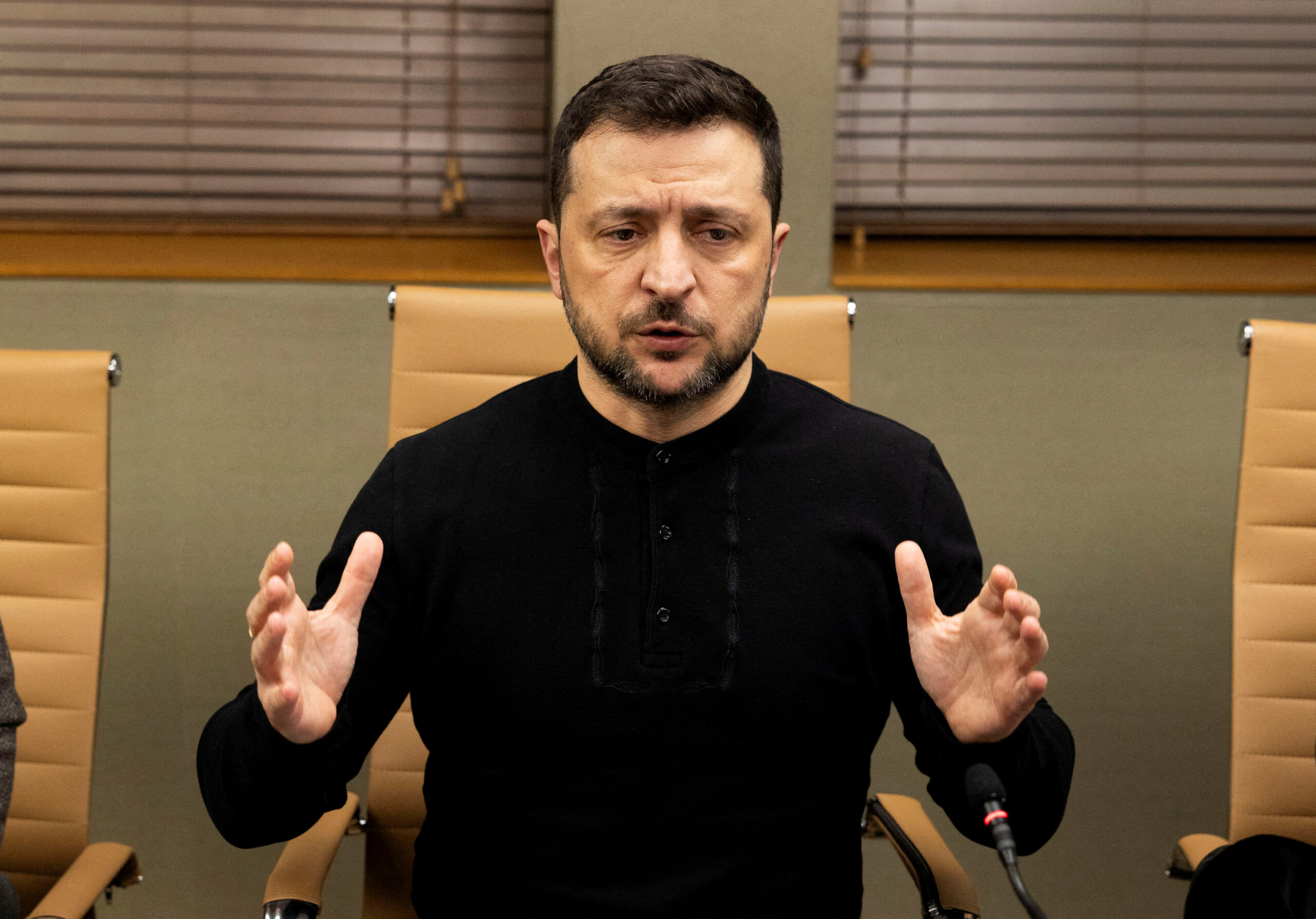
After the president of the United States, Donald Trump, and his Ukrainian counterpart, Volodymyr Zelenskyy, had a heated exchange in the White House last Friday, on Monday they faced at a distance about a possible end of the conflict.
President Donald Trump said that what was said by his Ukrainian counterpart, about the end of the war that his country holds with Russia “is still very, far away”, is “the worst statement” that it could have made and that “the United States will not tolerate it for much longer!”
After Trump and Ukrainian president, Volodymyr Zelenskyy, had a heated exchange in the White House Last Friday, on Monday they faced remotely about the possible end of the conflict.
Zelenskyy expressed his opinion that it was unlikely that the war ended soon when London left Sunday night after gaining broad support from European leaders to continue military assistance to kyiv's forces and said he expected the same of the United States, the greatest benefactor of weapons in Ukraine.
“I think our relationship (with the United States) will continue, because it is more than an occasional relationship,” said Zelenskyy. “I think Ukraine has a sufficiently strong association with the United States of America” so that the aid continues to flow.
But Trump was reluctant to the conclusion of Zelenskyy and said Monday on the Truth social media platform: “It is what he was saying, this guy does not want peace as long as he has the support of the United States and Europe, at the meeting they had with Zelenskyy, he flatly declared that they cannot do the work without the United States.”
“It probably has not been a great statement in terms of demonstration of force against Russia,” Trump said. “What are you thinking about?”
Zelenskyy said later in X: “It is very important that we try to make our diplomacy really substantive to end this war as soon as possible.”
“We work together with the United States and our European partners and we hope to support the United States on the road to peace,” said Zelenskyy. “Peace is necessary as soon as possible.”
Trump has pressed to end the fighting, who have killed or wounded several hundred thousand Russian and Ukrainian combatants, along with Ukrainian civilians, but Zelenskyy has expressed fears that Trump is trying to resolve the conflict in more favorable terms for Moscow than for kyiv.
Russia currently has around a fifth of the territory of Ukraine internationally recognized and has gradually conquered territory in the fighting in eastern Ukraine. Peace negotiations have not been programmed.
Zelenskyy also said on Sunday that his country was still willing to sign an agreement on rare earth minerals with the United States and that he believes that relations with Trump can save.
It was expected that both parties signed an agreement last week during Zelenskyy's visit, but the agreement failed after the heated exchanges with Trump and the American vice president JD Vance.
Zelensky said on Sunday that Ukraine has the help of the United States in his fight against the Russian invasion that lasts three years.
“I think stopping that help will only benefit (Russian president, Vladimir) Putin,” said Zelenskyy. “And that is why, I believe that the United States and the representatives of the civilized world, the leaders of this world, will definitely not help Putin.”
During his Friday meeting, Trump described Zelensky as Ingrate and had requested the Mineral Agreement to reimburse the United States billions of dollars to aid he has provided to Ukraine.
Trump has promoted the need to put an end to war and has maintained a phone call with Putin, in addition to meetings of senior US officials with Russian officials in Saudi Arabia to discuss the early stages of a possible peace agreement without the participation of Ukrainian officials in the conversations.
Trump said Sunday in Truth Social: “We should spend less time worrying about Putin and more time worrying about the bands of immigrant rapists, the drug lords, the murderers and the people of mental institutions that enter our country, so that we do not end like Europe!” But after seeing Zelenskyy's comment about the peace prospects, Trump quickly attacked the Ukrainian leader.
That followed Sunday's conversations in London during which British Prime Minister Keir Starmer told 18 allies that with the United States hesitating in his support for Ukraine, Europe is “at a crossroads in history.”
The British leader said that without guarantees of the intervention of the United States to act as military support for the possible peace maintenance forces, “Europe must do heavy work” to ensure peace in Ukraine.
Mike Waltz, Trump National Security Advisor, told reporters on Monday: “We welcome Europeans to assume leadership in European security matters … They have to invest in the ability to do so. They have certainly demonstrated will. ”
But Waltz said that White House officials remain perplexed by the failure of the mining agreement between the United States and Ukraine, and that Zelenskyy “could have remained with an economic guarantee that would have benefited Ukraine, and I believe that the world, during a generation. Therefore, we are really disconcerting that we have received so much hostility. ”
Warm reception in Europe
Unlike what happened in Washington, Zelenskyy was warmly received at the summit by many European heads, along with Canadian Prime Minister Justin Trudeau, and NATO Chief, Mark Rutte. Zelenskyy supporters gathered in front of the Starmer residence in support of Ukraine.
While the leaders gathered on Sunday, the head of the European Commission, Ursula von der Leyen, warned: “We have to urgently rear to Europe” and “prepare for the worst” in the continent.
Starmer, when he first greeted Zelenskyy on Saturday, revealed a loan agreement of 2,840 million dollars to support Ukraine's defense capabilities, which will be reimbursed with the profits of the immobilized Russian sovereign assets. Starmer said Great Britain, France and Ukraine agreed to work in a high -fire plan to present it to the United States.
The Kremlin said in comments broadcast on Sunday that the dramatic change in United States foreign policy in Europe is largely aligned with Moscow's vision.
“The new administration is quickly changing all the configurations of foreign policy. This largely coincides with our vision,” said Kremlin spokesman Dimitri Peskov, in an interview with Russian state television recorded last Wednesday.
(With information from AP, AFY and Reuters)