
Exemplary teachers are currently booming in the cinema. In “Welcome to the mountains”, a teacher from Rome can be put into an Abruzzo village and fights for the preservation of a mini school. In the drama “The teacher who promised us the sea”, the protagonist tries to implement reform pedagogical ideas in a Spanish province. The story of true events plays shortly before the outbreak of the civil war in 1936. A remarkable example from last year was also the film “Radical”, which was also based on facts, in which a replacement teacher was the pupils of a problematic sixth grade in the Mexican border town of Matamoros With his unconventional lessons, learning to learn and teaches independent thinking.
“”Louise and the school of freedom“In these rounds, it is casual. In this case, however, story and staff are fictitious. However, the story could have happened in a very similar way – especially since it develops against a real historical background. The fact is that in France's third Republic (1870-1940) in 1882, schooling was introduced and teaching staff sent to the country in order to emphasize this obligation. The drama playing in this environment not only tells powerfully about the value of education itself, but also moving of a woman who is committed to her beliefs despite traumatic past.

Louise Violet (Alexandra Lamy) not only has to teach children, but also convince adults that general compulsory schooling is a good cause.
Around 1885, the teacher Louise Violet (Alexandra Lamy) obtained the assignment in a remote mountain village to introduce school lessons there. She is not welcome there. As accommodation, she must first make do with the stable of Mayor Joseph (Grégory Gadebois). For weeks, no child can be seen in their provisional school.
The parents prefer to use their offspring in agriculture where all hands are needed. After all, you do not have to be able to read or write. Only after Louise and the mayor turned a confidence -building round through the village did the learning location set up in the stable gradually fill up. But when a not insignificant event from the teacher's past comes to light, Louise's construction work threatens to …
A fine look that remains open in all directions
As “pear cake with lavender” (2015) and “à la carte” (2021), which was about the first French restaurant in history, the current work by director Éric Besnard is simply incredibly beautiful to look at. Cameraman Laurent Daillant succeeds in wonderful shots of landscape, nature and historical equipment. But the many idyllic pictures never quite mislead about the arduous everyday life of the mountain village population and their tedious placking in agriculture. Besnard also has an eye for this.
So it is no wonder that Louise initially encounters rejection in this milieu. While the teacher rightly propagates education as a way to personal (election) freedom, the adult village population-quite understandable-has afraid of change. In addition, there is the uncertainty that can arise when the children know more than yourself. And what happens when they go away to seek happiness elsewhere? Socially progressive thoughts come across rural conservatism that includes the reluctance to socialist or even communist land redistribution ideas. Besnard, who also wrote the script, uses this area of tension for sensitive observations.
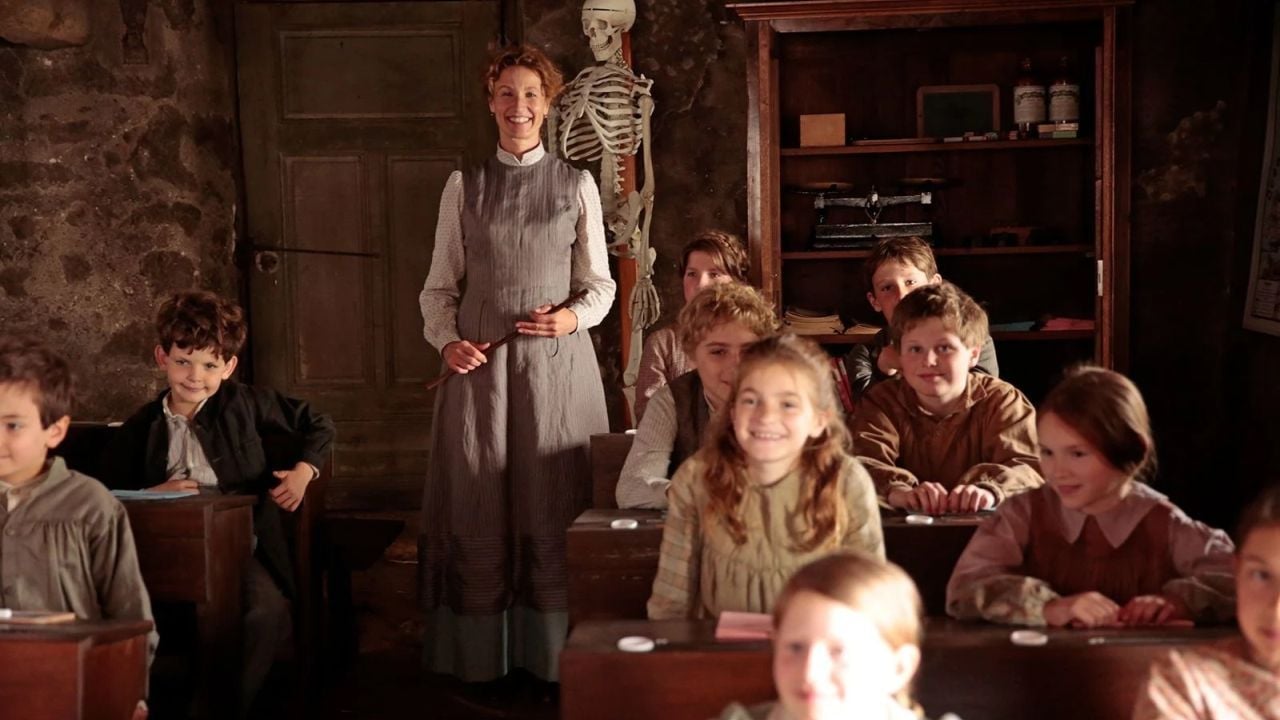
Even the teacher cannot be dissuaded from all kinds of setbacks from her mission.
As a result, he does not operate black and white painting during the figure drawing. For example, it is the village pastor Francis (Patrick Pineau), who is the first to meet the stranger. The mayor soon does that. The single father not only swings in Louise's line because he likes the teacher, but also because he definitely looks at the meaning of her mandate.
The way Grégory Gadebois (“Intrige”) swirls the teacher in his role, who also has the secretary of the mayor, the burial ground and church servant, has something touching and strange at the same time. The figure of the Rémi (Jérémy Lopez) is also multi -layered, who does not have to rant the entire film as a violent arch -patriarch. The script also shows understanding for the concerns and needs of this indebted farmer.
Only the postman ventilates the big secret
The linchpin of the story is of course the title heroine. Alexandra Lamy (“Welcome to Hotel Mama”) plays wonderfully as a woman who is convinced by her educational mission, who has to assert herself in a male -dominated environment and first fight for her place in the village community. At the same time, Louise surrounds a secret associated with great personal tragedy that should not be revealed here. This should be reserved for the curious postman Thermidor (Jérôme Kircher).
Conclusion: French drama, which runs on a historical background, for a strong woman with educational ideals who have to assert herself in the middle of a rough world and have to deal with her past. Tell told, nicely filmed, played great.