
What a fantastic comeback! After corresponding plans had repeatedly come to nothing over the years, the “Sunshine” dream team Danny Boyle (director) and Alex Garland (screenplay) finally got together to put together a third part of the “28 Days Later” zombie saga: their “28 Years Later” became a ruthless, strongly illustrated and surprisingly emotional continuation in 2025 – and was still only the beginning of something even bigger!
After all, “Ex Machina” mastermind Alex Garland wrote scripts for an entire “28 Years Later” trilogy. Part 2 was even shot immediately after the opening, although this time not by Danny Boyle, but by “Hedda” director Nia DaCosta. Although “28 Years Later: The Bone Temple” continues the chosen path consistently (and even a touch more brutally!), the sequel is also refreshingly different in many respects – and just as successful.
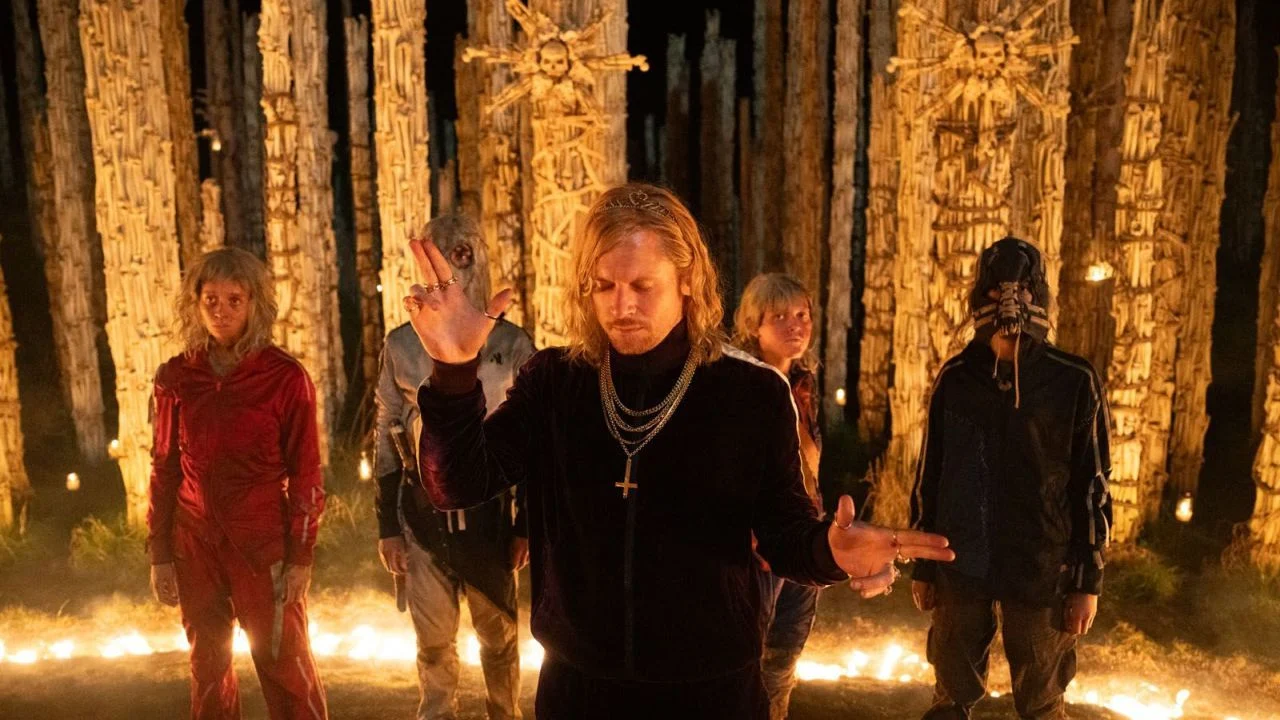
Jimmy Crystal (Jack O'Connell) goes around the country murdering and torturing with his devil-worshipping cult.
After the death of his mother, young Spike (Alfie Williams) turned his back on the safe island community and his father to make his own way on the mainland, which was overrun by infected people. When he meets the cult-like cult of the crazy Jimmy Crystal (Jack O'Connell), the encounter takes his fate into unexpected directions. Due to a lack of alternatives, Spike initially joins the ardent Satan worshipper, but soon desperately looks for a way out of the sadistic troupe that roams the country torturing and murdering.
Meanwhile, Dr. Kelson (Ralph Fiennes) undertakes a risky experiment. He hopes that somewhere in the alpha zombie (Chi Lewis-Perry), whom he named Samson, there is still something human after all – and therefore tries every means possible (including strong psychotropic drugs) to build a bond with him. But can he actually get through to the giant who is tearing out his spine?
But not an ironic slaughterfest
The absolutely crazy final scene of “28 Years Later” offended many viewers. When the film actually seemed to be over, Jimmy Crystal's wild gang suddenly appeared in their brightly colored tracksuits – and made short work of a horde of infected people with acrobatic martial arts tricks to hard metal sounds. Not everyone was happy about it because the sequence seemed completely different tonally than the rest of the film. But anyone who fears that the sequel will suddenly become a completely exaggerated, tongue-in-cheek, ironic slaughterfest with exactly this vibe can be reassured straight away.
Instead, “The Bone Temple” cleverly uses the deliberately alienating final chord of its predecessor to immediately become maximally disturbing: in one scene, a member of Jimmy's gang performs an embarrassing Teletubby dance, but in the next moment the cultists with their blonde wigs are mercilessly ripping the skin from a victim's body. Behind the insane facade, the inevitable is already brewing – and later it breaks out even more violently. Given the absolute helplessness of Jimmy's victims, this is at times almost unbearable. The fact that the opening of “The Bone Temple” promises more civilization after the wilderness odyssey of its predecessor with an urban setting, only to have the characters in it act all the more uncivilized, is a brilliant and appropriately cynical trick.
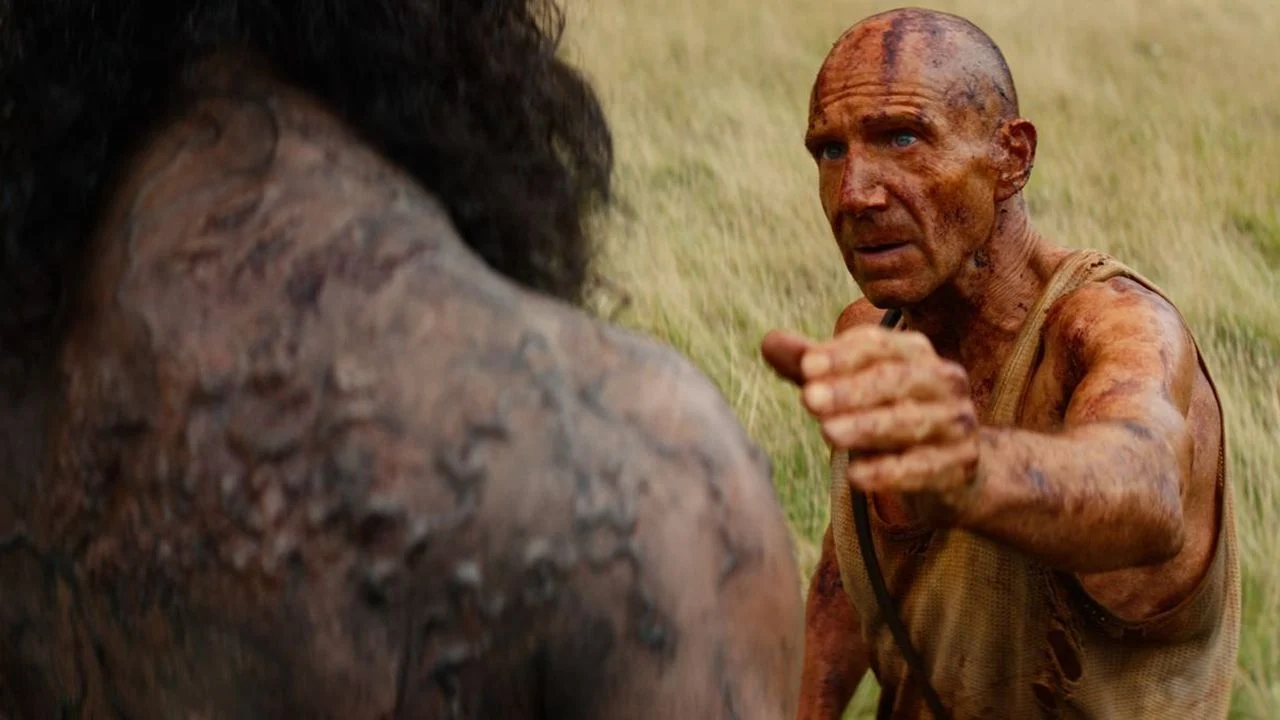
The approach of Dr. Kelson (Ralph Fiennes) and his alpha zombie Samson is not only touching, but also surprisingly humorous.
Yes, the Jimmys are idiots – but dangerous idiots. Garland and DaCosta illustrate how fanaticism and blind faith can cause even a small group to cause such great suffering. With Garland, it is hardly surprising that swipes at certain political power structures and executives can also be read into this. But even without this additional layer, the six-pack brings in a very unique note when “28 Years Later” – as is the good tone of the zombie genre – once again demonstrates more strongly that it is not the infected, but the people who are the real monsters.
The fact that it works so well is primarily due to Jimmy Crystal himself – or rather his actor Jack O'Connell. Just shortly after the horror highlight “Blood & Sinners,” the former “Skins” star shines again with an incredibly menacing villain performance that outshines pretty much every scene in which he appears – unless Ralph Fiennes gets involved too. Behind all the satanic theatrics, a hint of Jimmy's traumatic past always shines through, which – in combination with the prologue about Jimmy's childhood at the beginning of “28 Years Later” – even gives the character a subtly tragic note. Of course, without the merciless devil worshiper suddenly gaining sympathy points or even being softened.
Not a simple copy
With the clear focus on Jimmy, his followers fade into the background. That wouldn't be too tragic, but that also applies to Spike in some cases. The protagonist from “28 Years Later”, who impressed so much not least thanks to the engaging performance of newcomer Alfie Williams, becomes a pawn under Jimmy’s thumb, reacting rather than acting. On the other hand, his coming-of-age story continues when, after his voluntary departure from his sheltered home, he is now mercilessly confronted with the harsh reality of “real life”.
This time, however, the focus is clearly somewhere else – and not just from a narrative perspective, but also from an emotional perspective. This is where the second storyline comes into play, which, despite familiar characters and places, also makes a decisive contribution to the fact that “28 Years Later: The Bone Temple” continues the series seamlessly, but is not just a copy of “28 Years Later”. While the first setting in a swimming pool suggests a certain degree of civilization, which is then further perverted by Jimmy's gang in an unstoppable spiral of violence, Dr. Kelson and Samson are a clever antithesis: they may live in the wilderness and, in the case of Samson, even follow their instincts alone, but pure humanity oozes from their (partly drug-induced) interactions.
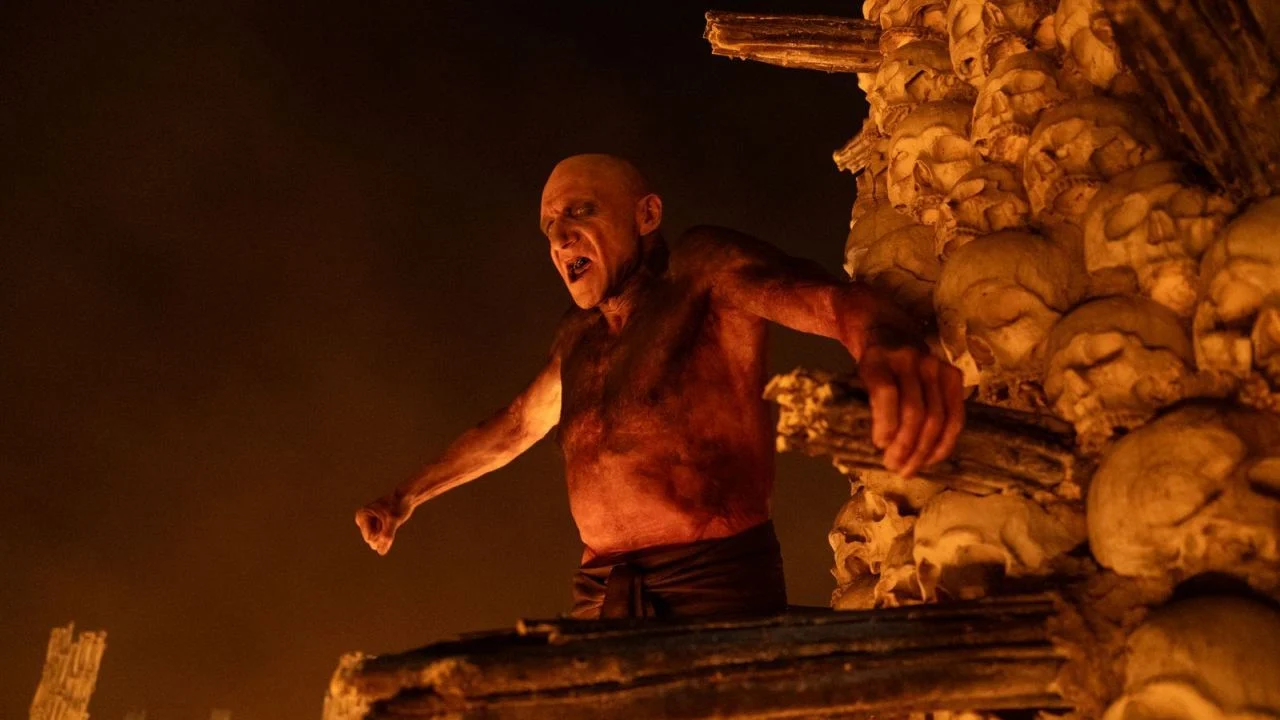
The finale of “28 Years Later: The Bone Temple” is already one of the craziest – and best! – Movie scenes of the year.
At the beginning we see Samson happily eating a human brain, and Dr. Kelson, taking away the alpha's berserker rage will eventually bear fruit. Ralph Fiennes, who is particularly great this time, and Chi-Lewis Perry, who once again shines with his impressive physique, develop an amazing buddy dynamic that creates some tender, sometimes even deliberately silly moments. And yet, for a long time, the exciting uncertainty hovers over everything as to whether Kelson is really making a difference or whether he is wandering off into a utopian dream that will immediately burst when he runs out of narcotics for his “friend”.
The ultimate payoff for the two-lane structure occurs when the two strands inevitably meet. Here Nia DaCosta brings up some of the madness that Danny Boyle hinted at in the final sequence of “28 Years Later”. The completely unleashed (theatrical) interlude already inspired the motif of the teaser poster, but no one should have seen it coming in this form. Back in January, it was one of the highlight sequences of the cinema year, which, as a rush of driving music, fiery images and unbridled acting, quite rightly caused disbelieving, joyful applause.
Conclusion: “28 Years Later: The Bone Temple” pushes the great main character from its predecessor to the sidelines, but compensates for this with a sophisticated interplay of emotionally amusing zombie buddy story and gut-wrenching nihilistic gore. An equally intense, albeit very unique, zombie shocker whose thunderous finale is unparalleled. In any case, we can hardly wait for the conclusion of the trilogy, which has now fortunately been confirmed.