
Everyone complains about young people who no longer know what real work is because of the work-life balance. But woe betide you if the supposedly lazy generation does get out of hand – that’s when things really get messed up. This is also the case with the NGO “Jugend Rettet”, whose members have sacrificed themselves for sea rescue in the Mediterranean since 2015 – and as a reward were brought to court with a maximum prison sentence of 20 years. Particularly perfidious: There was also a fine of 15,000 euros – for each of the 23,000 lives saved!
In 2018, when the scandalous trial in Italy was still ongoing, the documentary filmmaker Michele Cinque had already made a film about “Youth Saved” with “Iuventa. Sea Rescue – An Act of Humanity”. Now he has also worked on the script for the feature film version “23 000 Lives” alongside director Markus Goller (“25 km/h”) and his regular screenwriter Oliver Ziegenbalg (“One For The Road”). However, the Netflix project fails to coherently condense the nine-year odyssey into less than two hours – and in the process turns the people significantly involved into flesh and blood people.

“23,000 Lives” was shot in the same offshore studios as the mega-productions “James Bond 007 – Casino Royale” and “Troy”.
While his girlfriend Kitty (Mala Emde) tackles her law studies, Lukas (Louis Hofmann) decides against the wishes of his lawyer mother (Franka Potente) to take an activist break. The feeling of simply having to do something is too strong given the world situation. His – perhaps somewhat naive – plan: Simply buy a boat and then save people in the Mediterranean who are in danger of dying while escaping on overcrowded inflatable boats. And in fact: the first calls for help via flyers go almost unheard.
But then at some point “Jugend Rettet” gains momentum: While banks, aid organizations and MPs give up, a private couple from Kreuzberg (Corinna Harfouch, Ulrich Matthes) jumps into the breach and buys the ship. The German Film Academy sponsors an office – and Katja Riemann (playing herself) acts as a fundraising ambassador. But of course the world looks completely different on the water – and after the European states initially just watched idly, they are increasingly beginning to actively place ever larger obstacles in the way of the sea rescuers…
A timely film
The trial against the crew of the Iuventa ended in 2024 – and one could therefore argue that the film is actually a few years too late. But especially now, when the topic has largely disappeared from the headlines and rejection feels like it has become the new mainstream opinion, the very fact that “23,000 Lives” is now appearing on Netflix has a certain, hopefully discussion-provoking potential. In contrast to the film itself, by the way, which is as smooth as you can imagine. The attempt to fit as many stations as possible into just 112 minutes resulted in an illustrated Wikipedia entry for much of it.
The sheer number of guest stars alone shows how willing everyone was to support the cause. But the good intentions may have also meant that in the end the fear of doing something wrong reigned supreme. In the film, even friends speak to each other as if they were only communicating using talking points that they had memorized for their next media appearance. No matter how courageous the top-class young cast around the Netflix-experienced Louis Hofmann (“Dark”) and shooting star Mala Emde (“Köln 75”) can act, there is hardly any way around the overly dry, academic dialogues.
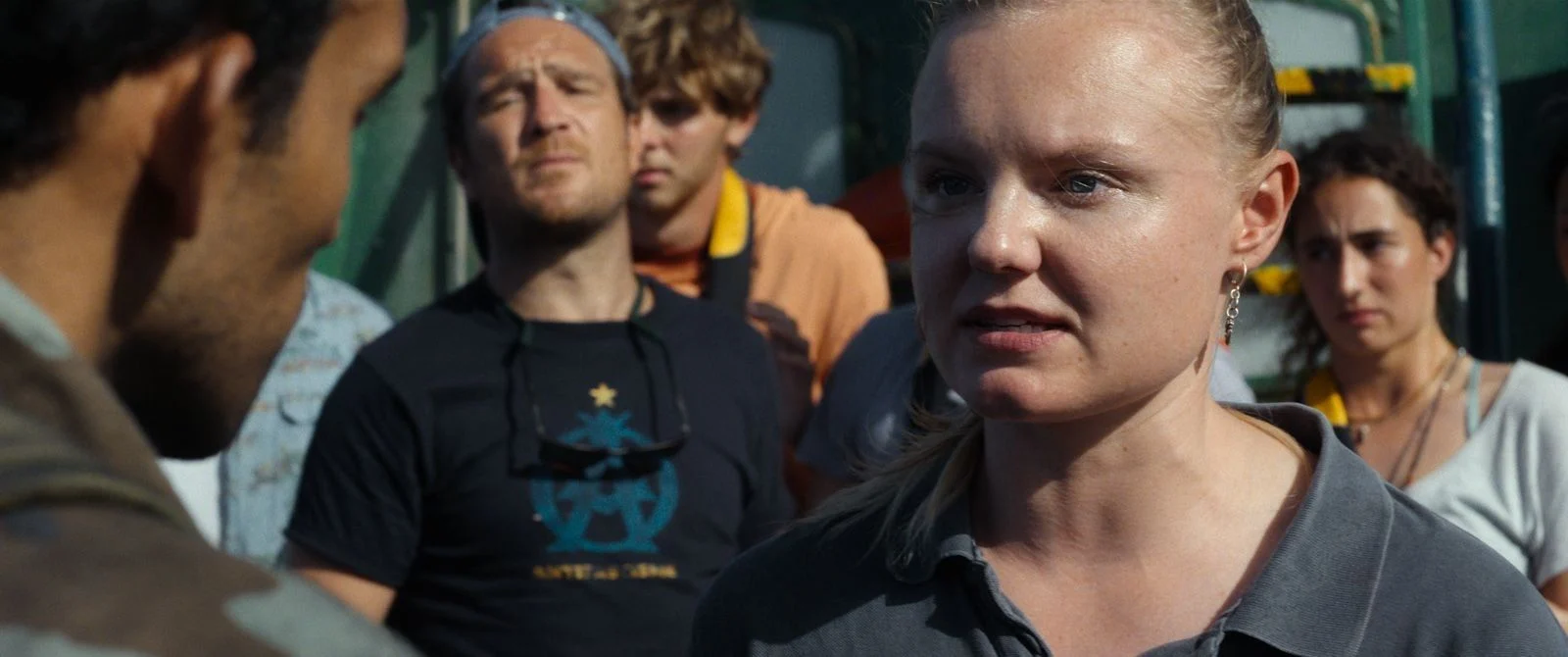
Captain Viola (Maria Dragus) and Head of Mission Sören (Frederick Lau) have everything under control on board the Iuventa.
Unless I’m completely misremembering, there isn’t a single moment in the entire film that doesn’t directly relate to the theme of 23,000 Lives. Despite the title, there is a lack of liveliness. The scenes on the high seas with the captain Viola (Maria Dragus) and the head of mission Sören (Frederick Lau) are the most thrilling. Filmed in the same Mediterranean water tanks as “Troy” and “Casino Royale”, there are quite surprising insights here – for example, when it comes to the fact that the rescuers not only pick up the people crammed into the inflatable boats, but also sink the boats left behind in order to scare off the motor hunters who are already lurking like vultures.
The central internal conflict, namely whether one should cooperate without hesitation with the authorities, even if they obviously no longer adhere to the law and morals, is only touched on superficially. What remains of “23,000 Lives” is the emphatic plea to dare to be more naive, to not always just think about possible ways of failure, but rather to simply tackle such urgent things from a certain point onwards.
Conclusion: A portrait of the sea rescuers from “Jugend Rettet” that flies by all too smoothly and therefore only scratches the surface, which – unfortunately – gains potential for friction primarily because the very existence of a film like “23,000 Lives” is now seen by many as a provocation.